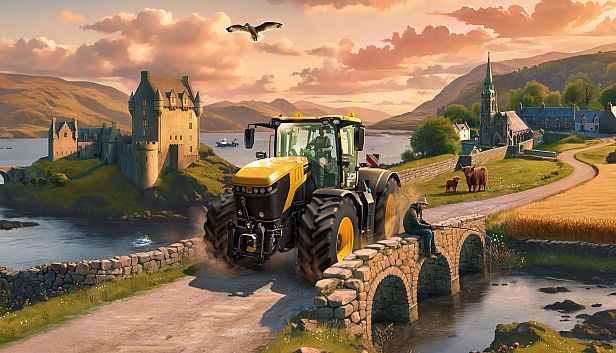



















Farming Simulator 25: Highlands Fishing Edition is a simulation title that places players in charge of running expansive agricultural operations across multiple continents. The package combines the core Farming Simulator 25 experience with the Highlands Fishing Expansion, adding aquaculture mechanics to the established mix of crop cultivation, forestry, and livestock management. Players handle everything from planting and harvesting to equipment maintenance and resource sales on four distinct maps that span North America, Central Europe, East Asia, and a Scotland-inspired setting called Kinlaig.
Gameplay
The core loop revolves around planning seasonal activities, operating a wide range of vehicles and tools, and expanding operations through production chains. With 26 crops available, including rice paddies in the East Asian map and onions introduced via the expansion, players rotate plantings, manage soil conditions, and transport goods to sell at varying market prices. Forestry tasks involve cutting timber and processing wood, while animal husbandry covers feeding, breeding, and selling livestock such as highland cattle on the new Kinlaig map. The expansion integrates fishing and aquaculture, allowing players to operate boats, tend fish stocks in open waters, and incorporate seafood into farm outputs alongside traditional crops and animals. Over 400 machines from more than 150 real-world brands handle fieldwork, transport, and specialized water-based tasks, with realistic physics governing equipment handling and terrain interaction.
Progression centers on acquiring land, upgrading infrastructure like grain elevators and ponds, and balancing multiple revenue streams. Single-player sessions let individuals build from scratch or take over established farms, while cooperative multiplayer supports shared operations where participants divide roles such as fieldwork, animal care, or fishing runs. The four maps each present unique environmental challenges, from winding rivers and historic structures in North America to lush rice fields and rolling hills with open waters in Kinlaig.
Game Modes
New Farmer mode provides a guided entry point with a pre-established farm, basic fields, and essential equipment to reduce initial complexity. Career-style progression appears through ongoing farm development, where players set their own goals around expansion, production efficiency, and financial targets without strict time limits. Multiplayer sessions enable cooperative play on shared servers, allowing groups to manage large-scale operations together across any of the included maps.
Maps and Expansion Features
Each of the four maps supports distinct farming styles. North American terrain features rivers and grain elevators suited to large-scale grain operations. Central European areas emphasize pond-based activities and varied field layouts. East Asian landscapes focus on rice cultivation in terraced paddies. Kinlaig introduces highland cattle, onions as a new crop, and dedicated fishing zones with boats and water-based equipment. The expansion adds over 20 specialized machines for land and water use, plus new animal types and fish management systems that integrate directly into existing production lines.
Is It Worth Playing?
Player feedback highlights the title as a detailed and satisfying simulation that rewards careful planning and long-term management. Recent reviews describe it as the strongest entry in the series for newcomers due to refined systems and the added depth from aquaculture and the Kinlaig map. The game maintains active development, with the latest update released in July 2026 addressing balance and features. It suits players who enjoy methodical, open-ended experiences focused on realistic farm operations rather than fast-paced action. Those seeking a relaxing yet intricate simulator with strong vehicle variety and cooperative options will find substantial content across the bundled edition. The steep initial learning curve benefits from the tutorial and New Farmer mode, after which the gameplay settles into a meditative rhythm of seasonal tasks and incremental growth.