


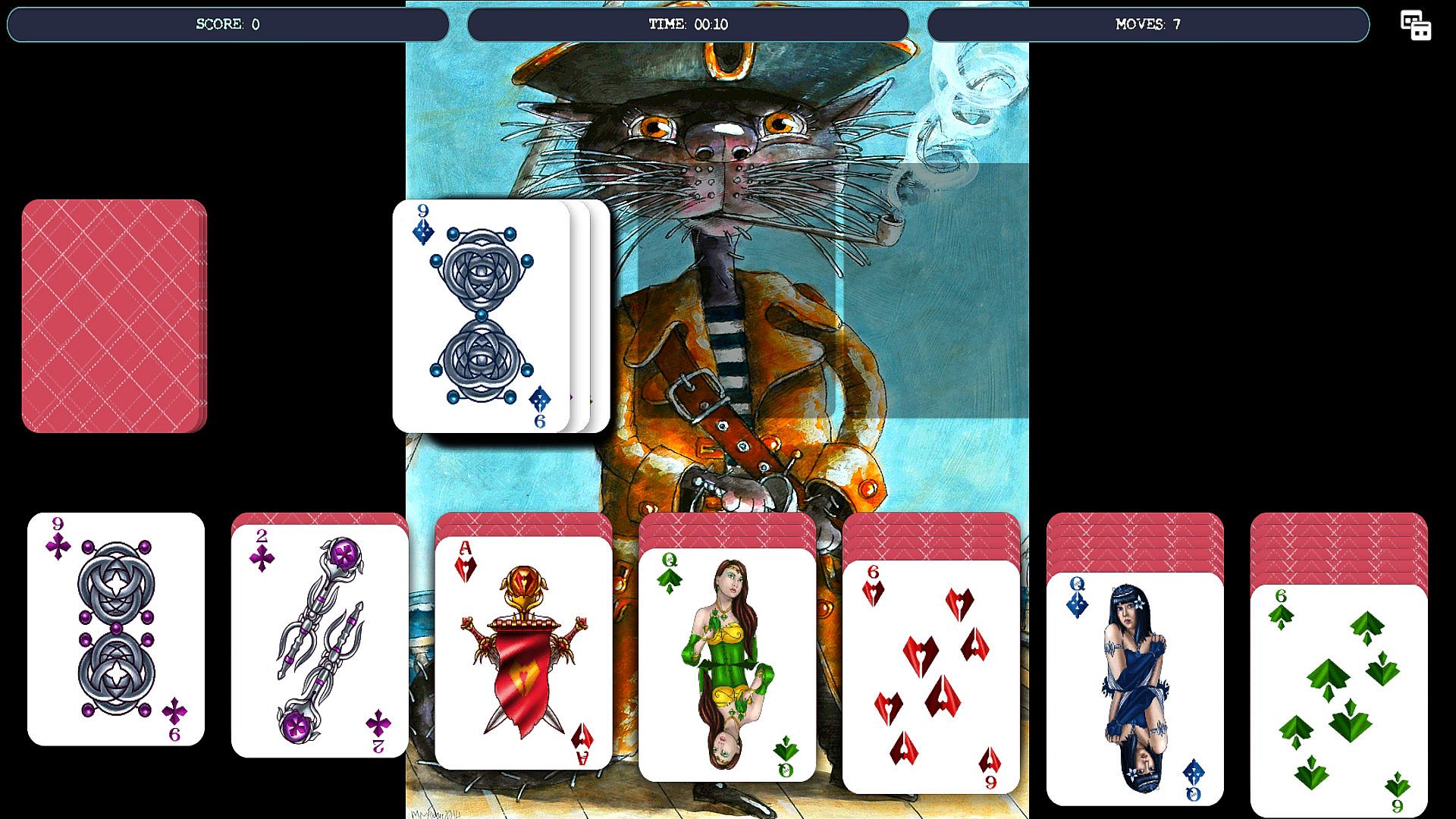
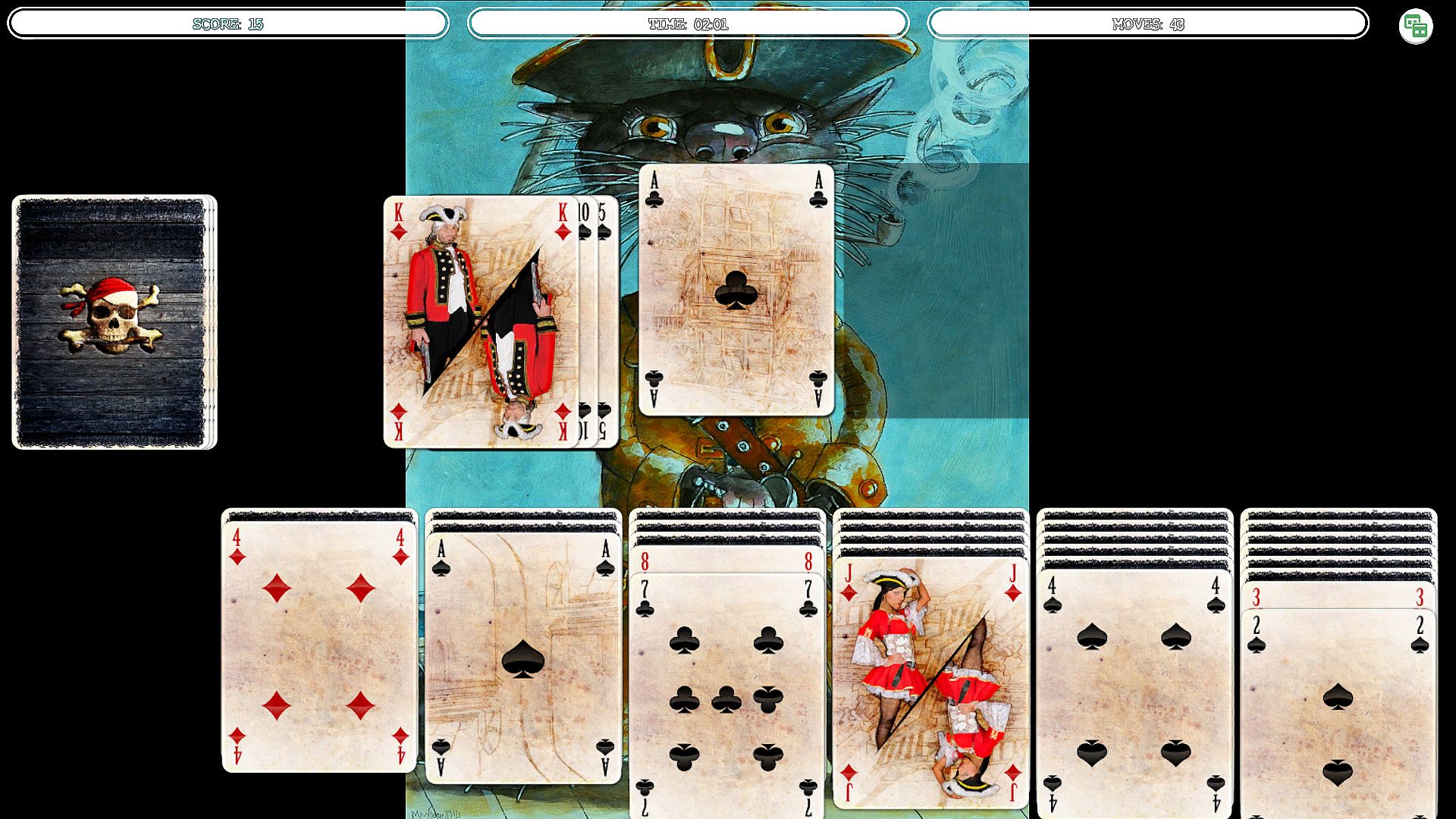
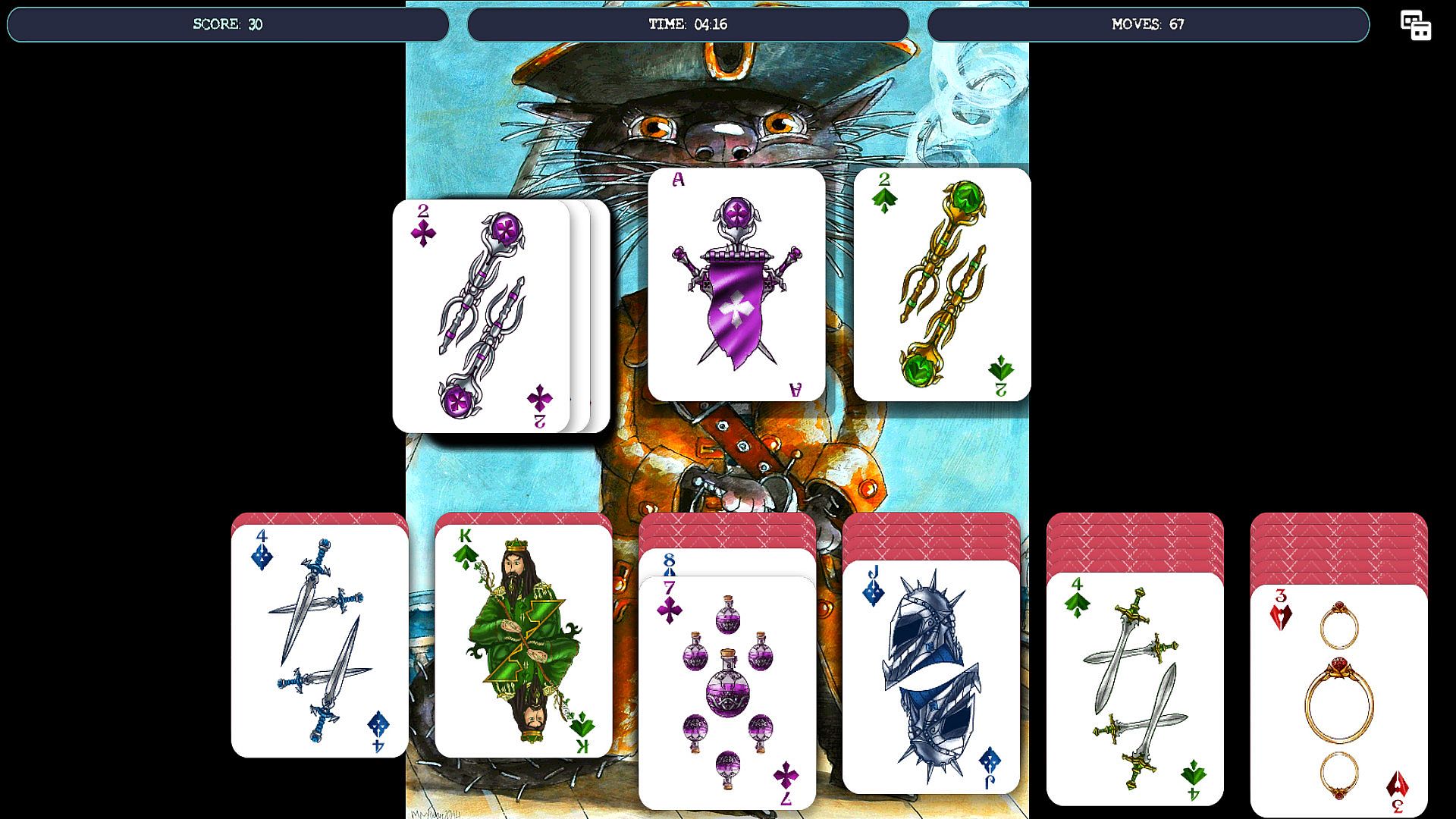

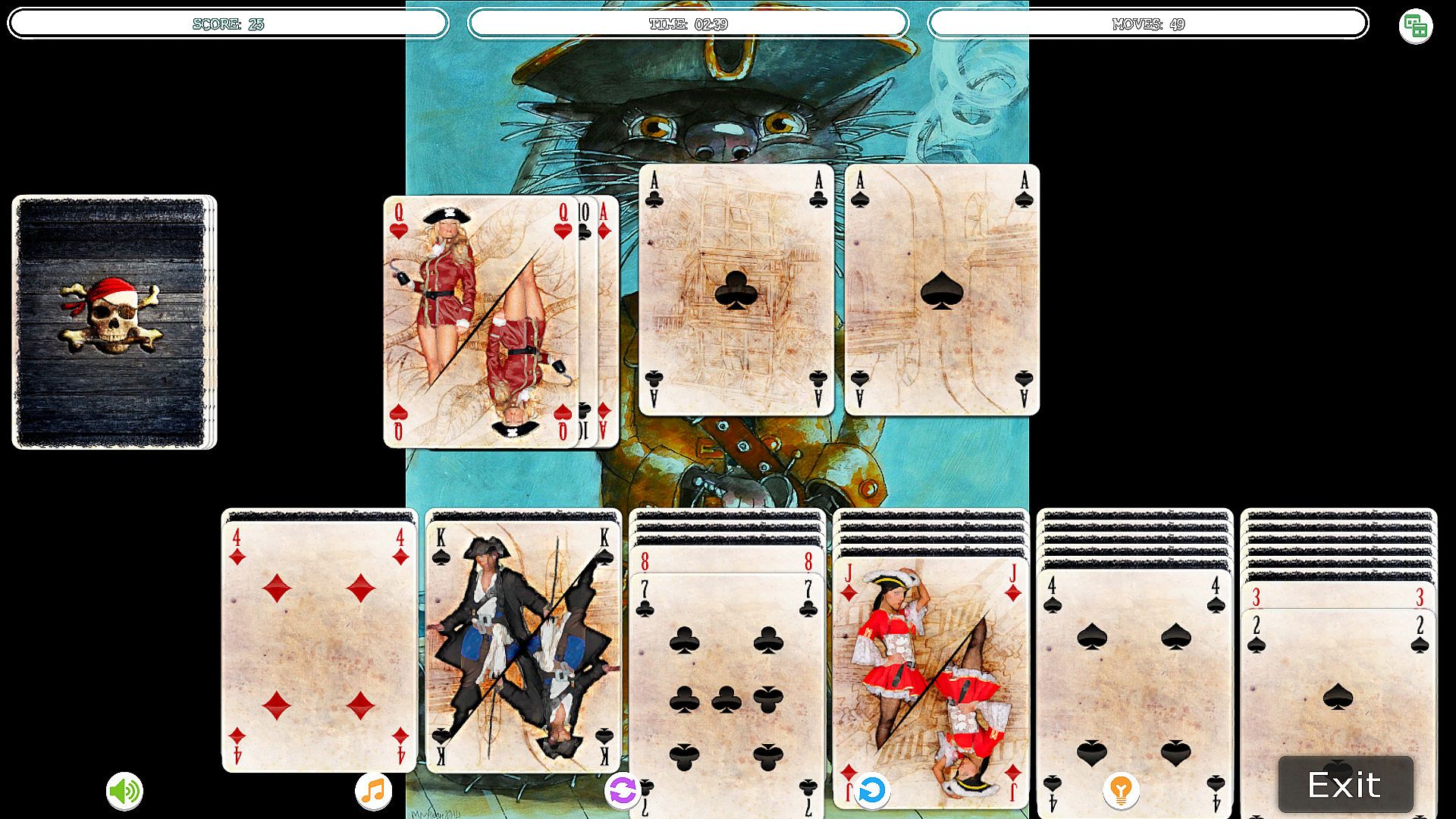
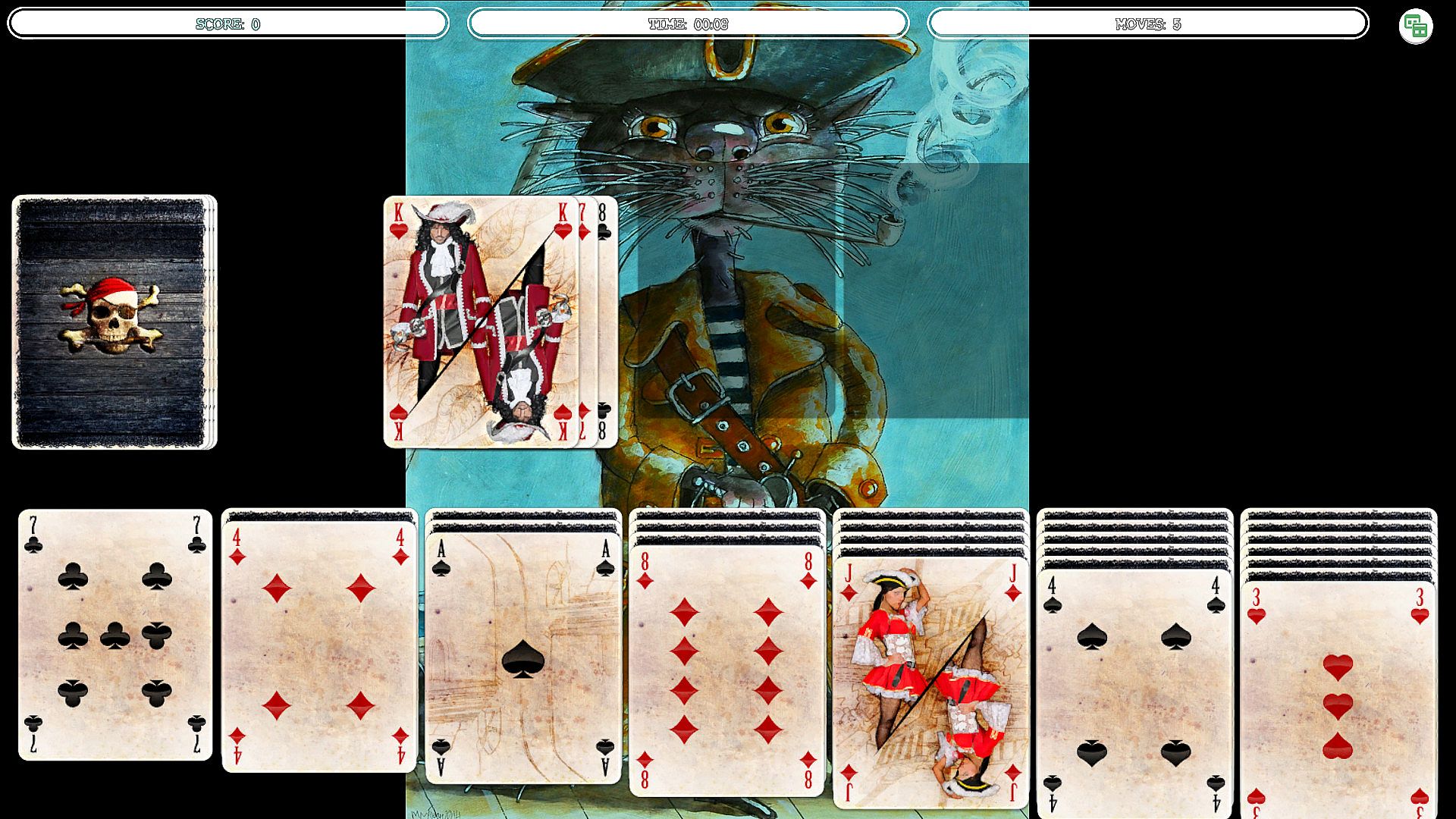
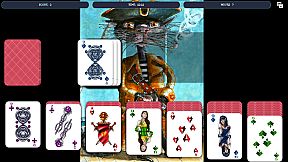
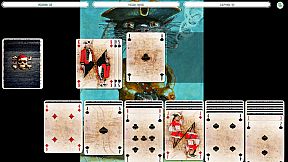
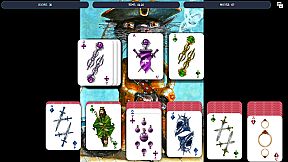
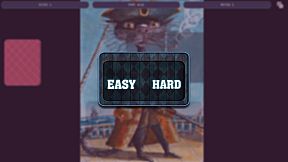
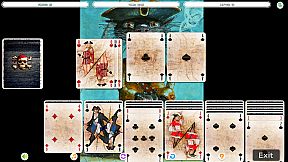
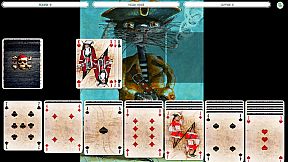
Solitaire - Cat Pirate Portrait - Experience the crisp, clear, and easy to read cards, simple and quick animations, and nice sounds, you can play with portrait views.
You can move cards with a single tap or drag them to their destination. You can either play the easy Draw 1 games where most games are winnable or if you feel up to the challenge, try your luck with Draw 3 and Vegas play modes. You can undo your last move.
Featues:
- 2 Card Themes
- Draw 1 card (Easy)
- Draw 3 cards (Hard)
- Time/Moves show your progress
- Standard Scoring Rules
- Unlimited Undos
- Unlimited Hints
- Tap or Drag cards
Rules
Many Solitaire games can be played on areas smaller than a card table. Others require a larger playing area, and these games are often played on the floor or on a bedspread. Alternatively, in order to play with large layouts on a card table, miniature playing cards are available. These are usually half the size of standard playing cards.
The Pack
Virtually all Solitaire games are played with one or more standard 52-card packs. Standard Solitaire uses one 52-card pack.
Object of the Game
The first objective is to release and play into position certain cards to build up each foundation, in sequence and in suit, from the ace through the king. The ultimate objective is to build the whole pack onto the foundations, and if that can be done, the Solitaire game is won.
Rank of Cards
The rank of cards in Solitaire games is: K (high), Q, J, 10, 9, 8, 7, 6, 5, 4, 3, 2, A (low).
The Deal
There are four different types of piles in Solitaire:
The Tableau: Seven piles that make up the main table.
The Foundations: Four piles on which a whole suit or sequence must be built up. In most Solitaire games, the four aces are the bottom card or base of the foundations. The foundation piles are hearts, diamonds, spades, and clubs.
The Stock (or “Hand”) Pile: If the entire pack is not laid out in a tableau at the beginning of a game, the remaining cards form the stock pile from which additional cards are brought into play according to the rules.
The Talon (or “Waste”) Pile: Cards from the stock pile that have no place in the tableau or on foundations are laid face up in the waste pile.
To form the tableau, seven piles need to be created. Starting from left to right, place the first card face up to make the first pile, deal one card face down for the next six piles. Starting again from left to right, place one card face up on the second pile and deal one card face down on piles three through seven. Starting again from left to right, place one card face up on the third pile and deal one card face down on piles four through seven. Continue this pattern until pile seven has one card facing up on top of a pile of six cards facing down.
The remaining cards form the stock (or “hand”) pile and are placed above the tableau.
When starting out, the foundations and waste pile do not have any cards.
The Play
The initial array may be changed by "building" - transferring cards among the face-up cards in the tableau. Certain cards of the tableau can be played at once, while others may not be played until certain blocking cards are removed. For example, of the seven cards facing up in the tableau, if one is a nine and another is a ten, you may transfer the nine to on top of the ten to begin building that pile in sequence. Since you have moved the nine from one of the seven piles, you have now unblocked a face down card; this card can be turned over and now is in play.
As you transfer cards in the tableau and begin building sequences, if you uncover an ace, the ace should be placed in one of the foundation piles. The foundations get built by suit and in sequence from ace to king.
Continue to transfer cards on top of each other in the tableau in sequence. If you can’t move any more face up cards, you can utilize the stock pile by flipping over the first card. This card can be played in the foundations or tableau. If you cannot play the card in the tableau or the foundations piles, move the card to the waste pile and turn over another card in the stock pile.
If a vacancy in the tableau is created by the removal of cards elsewhere it is called a “space”, and it is of major importance in manipulating the tableau. If a space is created, it can only be filled in with a king. Filling a space with a king could potentially unblock one of the face down cards in another pile in the tableau.
Continue to transfer cards in the tableau and bring cards into play from the stock pile until all the cards are built in suit sequences in the foundation piles to win!
Info
Patience, or solitaire as it is known in the US and Canada, is a genre of card games that can be played by a single player. Patience games can also be played in a head-to-head fashion with the winner selected by a scoring scheme.
In the US, the term solitaire is often used specifically to refer to solitaire with cards, while in other countries solitaire specifically refers to peg solitaire. Both Solitaire and Patience are sometimes used to refer specifically to the Klondike form of Patience.
The purpose of Patience generally involves manipulating a layout of cards with a goal of sorting them in some manner. It is possible to play the same games competitively (often a head to head race) and cooperatively.
Patience games typically involve dealing cards from a shuffled deck into a prescribed arrangement on a tabletop, from which the player attempts to reorder the deck by suit and rank through a series of moves transferring cards from one place to another under prescribed restrictions. Some games allow for the reshuffling of the deck(s), and/or the placement of cards into new or "empty" locations. In the most familiar, general form of Patience, the object of the game is to build up four blocks of cards going from ace to king in each suit, taking cards from the layout if they appear on the table.
There is a vast array of variations on the patience theme, using either one or more decks of cards, with rules of varying complexity and skill levels. Many of these have been converted to electronic form and are available as computer games. Examples of variants on the familiar Patience theme that may be played with an ordinary pack of cards include Bisley and Prince Albert. Basic forms of Klondike solitaire and FreeCell come with every version of Microsoft Windows from Windows 3.0 (though FreeCell was introduced in Windows 95) to Windows 7. Ever since the release of Windows 8, Windows Store offers six unique card games which can be downloaded for free from in the form of the Collection. There are also many applications for Android and iOS.
History
The game is most likely German or Scandinavian in origin.[1] The game became popular in France in the early 19th Century reaching England and America in the latter half. The earliest known recording of a game of patience occurred in 1783 in the German game anthology Das neue Königliche L'Hombre-Spiel. Before this, there were no literary mentions of such games in large game compendiums such as Charles Cotton's The Compleat Gamester (1674) and Abbé Bellecour's Academie des Jeux (1674).
Patience was first mentioned in literature shortly after cartomantic layouts were developed circa 1765, suggesting a connection between the two. This theory is supported by the name of the game in Danish and Norwegian, kabal(e). An 1895 account describes a variant of the game exclusively used for cartomancy.[1]
The first collection of patience card games in the English language is attributed to Lady Adelaide Cadogan through her Illustrated Games of Patience, published in about 1870 and reprinted several times. Other collections quickly followed such as Patience by E. D. Cheney (1869), Amusement for Invalids by Annie B. Henshaw (1870), and later Dick's Games of Patience, published by Dick and Fitzgerald. Other books about patience written towards the end of the 19th century were by H. E. Jones (a.k.a. Cavendish), Angelo Lewis (a.k.a. Professor Hoffman), Basil Dalton, Ernest Bergholt, and Mary Whitmore Jones.