




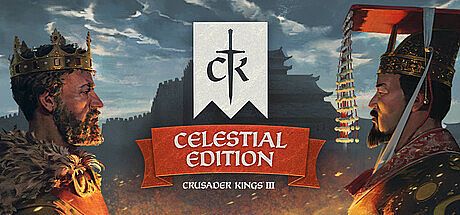



Crusader Kings III: Celestial Edition est un jeu de grande stratégie et de rôle se déroulant au Moyen Âge. Le joueur y dirige une maison noble sur plusieurs générations, en gérant ses domaines, ses titres et sa lignée à partir des dates de début 867, 1066 ou 1178.
Gameplay
Le cœur du jeu repose sur des décisions liées aux personnages qui façonnent une dynastie sur plusieurs siècles. Les souverains doivent organiser la succession, les mariages et les alliances tout en tenant compte des traits, des compétences et des relations qui influencent les événements à la cour comme sur les champs de bataille. La gestion du royaume passe par l'attribution des fiefs, la perception des impôts et la réaction aux événements nés des tensions culturelles, religieuses et politiques.
La guerre combine le commandement des armées et l'intervention de chevaliers dotés de capacités propres. La diplomatie et les intrigues permettent d'étendre son influence sans recourir à la force, que ce soit en fabriquant des prétentions ou en scellant des unions stratégiques. Le type de gouvernement Céleste ajoute un système bureaucratique fondé sur le mérite acquis par les actes ou les examens, ainsi qu'un trésor impérial servant à financer des projets et à maintenir la stabilité régionale à travers un cycle dynastique d'ordre et de troubles.
Modes de jeu
En solo, le joueur contrôle entièrement une maison et son héritage sans intervention extérieure. Le mode multijoueur permet des parties en ligne où plusieurs participants évoluent dans le même monde, en rivalité ou en coopération sur des cartes partagées.
Des règles de jeu permettent d'ajuster des paramètres tels que le respect de l'histoire ou les mécaniques d'indépendance afin d'adapter chaque partie. Le mode Ironman impose des sauvegardes permanentes et interdit le changement de personnage pour ceux qui recherchent un défi plus strict.
Mécaniques et fonctionnalités principales
La simulation des personnages suit leur santé, leur stress et leurs ambitions, qui influencent leurs décisions et leur succession. Les systèmes de culture et de foi permettent aux souverains de réformer les traditions ou de diffuser leurs croyances pour consolider leur royaume. La carte s'étend de l'Europe jusqu'à l'Asie de l'Est, les mécaniques Célestes apportant une gestion centralisée et un contrôle de l'influence dans les territoires chinois.
Les événements et les décisions offrent des embranchements narratifs liés à des souverains ou des régions précises. Les grands projets et les options de gouvernement approfondissent la stratégie dans les mises à jour ultérieures.
Est-ce que ça vaut le coup d'y jouer ?
Cette édition s'adresse aux joueurs qui privilégient une stratégie détaillée et une planification sur le long terme plutôt qu'une action rapide. Le jeu continue d'évoluer grâce aux extensions qui ajoutent de nouveaux types de gouvernement et de nouveaux systèmes régionaux.
Ceux qui apprécient la construction dynastique, les manœuvres politiques et la simulation historique y trouveront une grande profondeur dans la gestion des lignées et de la stabilité du royaume. La combinaison d'un contenu riche en solo et d'options multijoueur élargit son attrait pour les parties individuelles comme collectives.
