









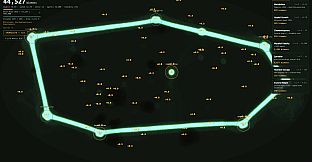
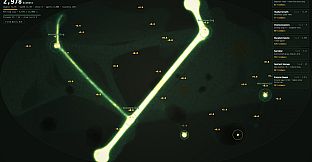
The Largest Organism is an indie casual simulation game built around the growth of a fungal network. Players manage a living colony that expands across simulated environments while competing against the scale of a real fungus in eastern Oregon that covers nine square kilometers and has existed for more than two thousand years.
Gameplay
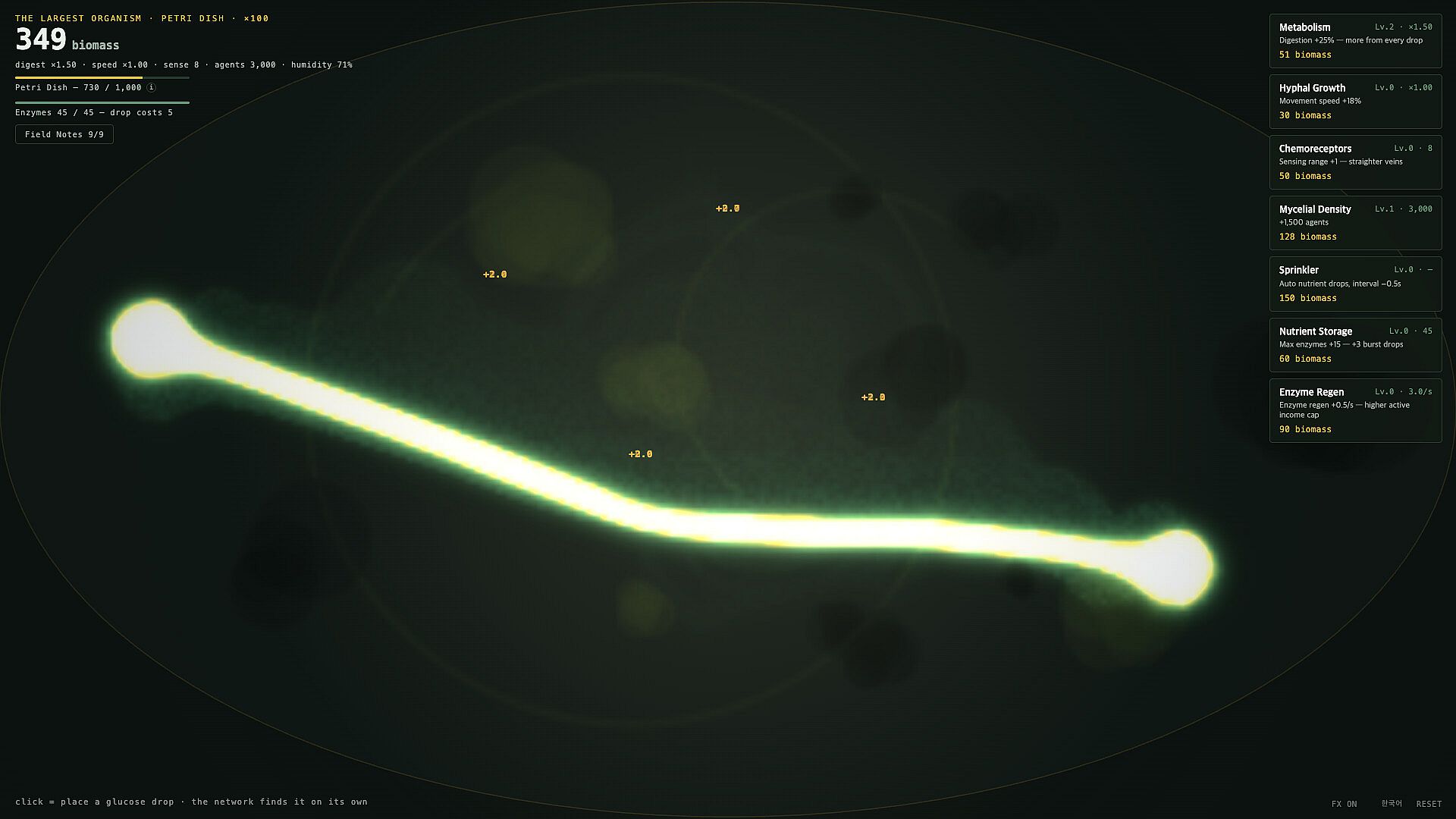
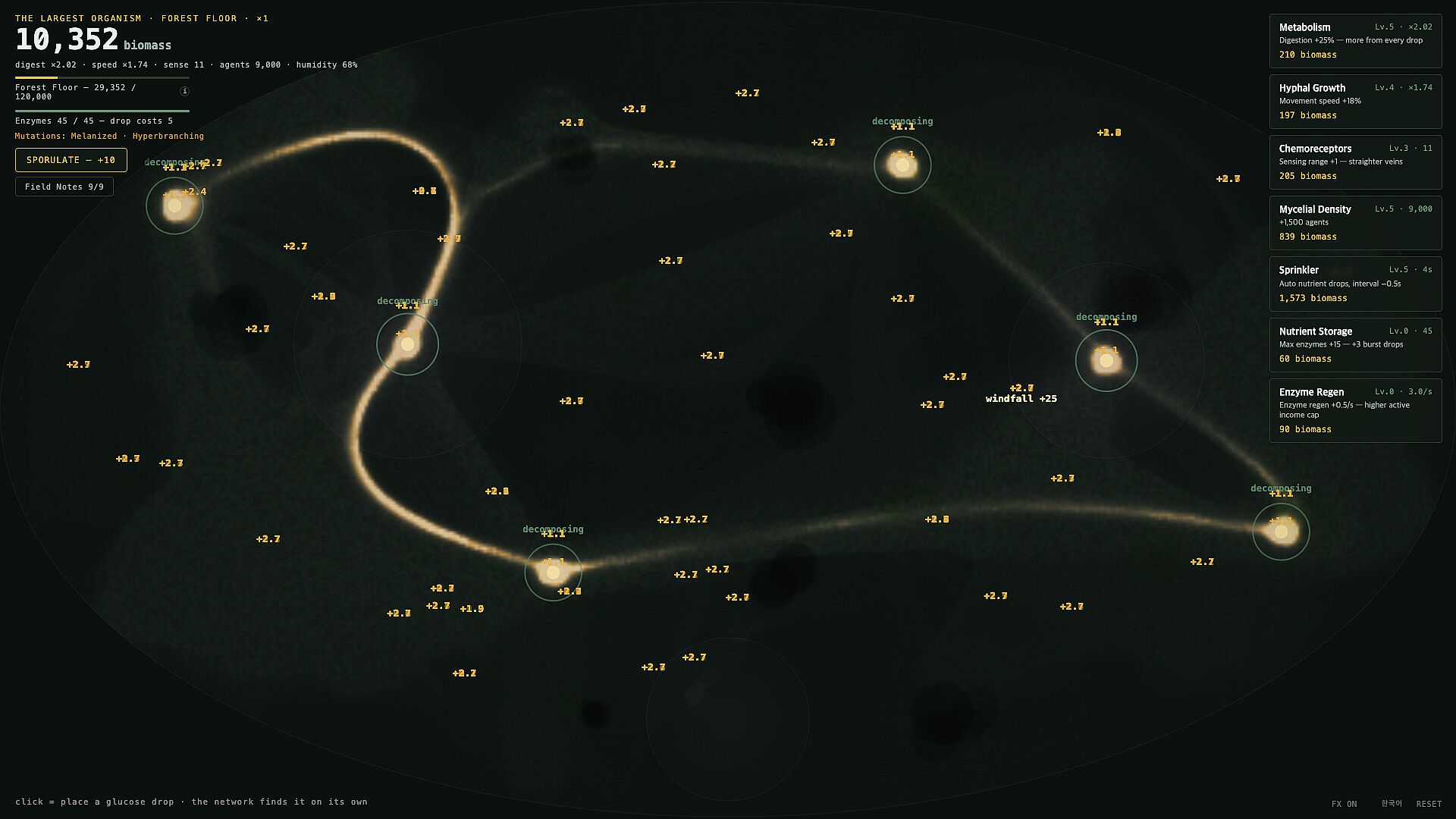
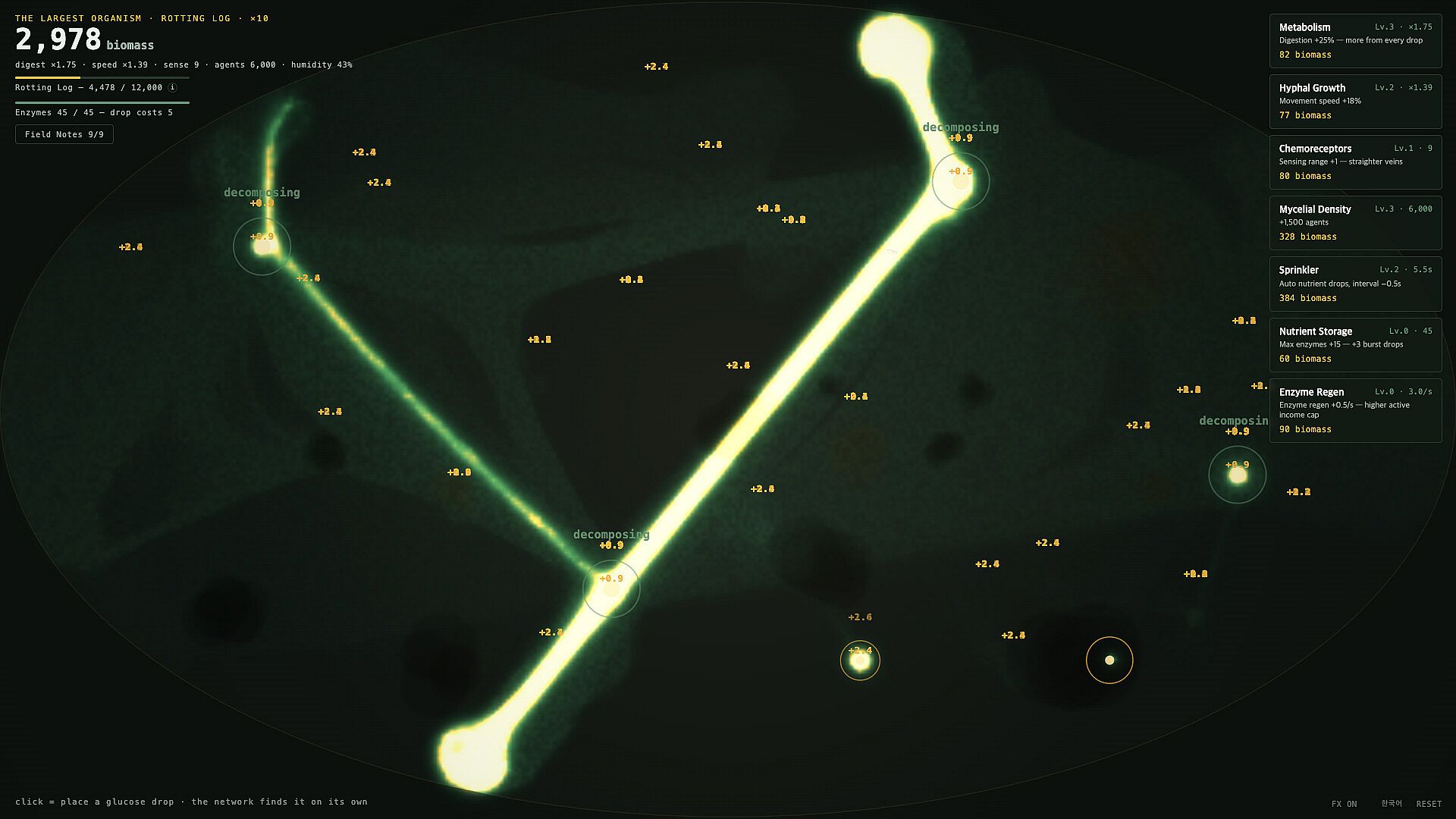
The core loop centers on directing thousands of individual simulated organisms that form veins, highways, and feeding clusters without any pre-scripted patterns. Structures appear through organic processes as the colony responds to conditions such as moisture levels. The network breathes and can send out unplanned scouting fronts when conditions allow.
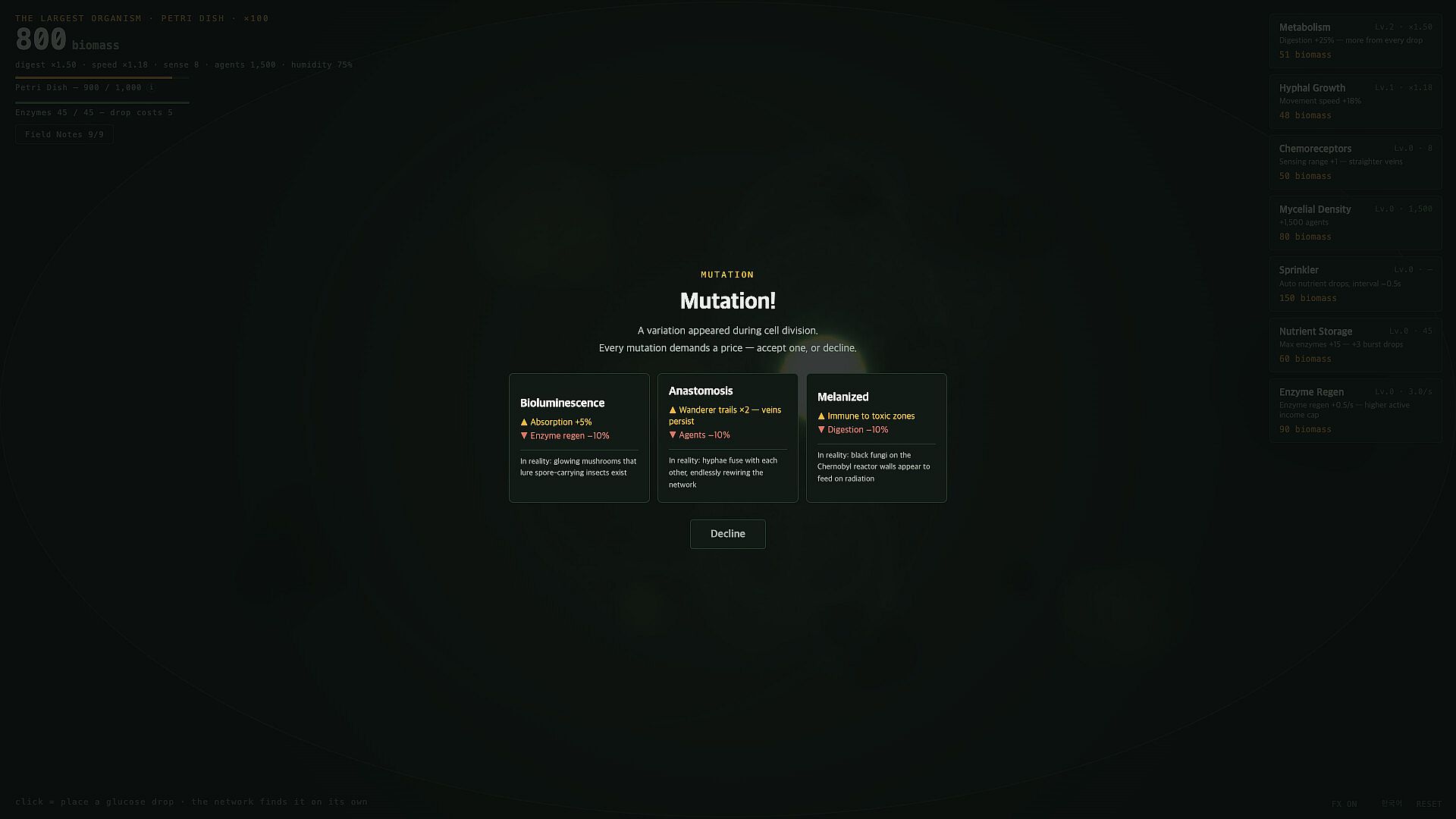
Upgrades alter colony behavior in meaningful ways. Choices in metabolism, growth speed, chemical sensing, and mycelial density produce visible differences in how the organism expands and interacts with its surroundings. Mutations function as trade-offs, where benefits in one area create costs in another, such as reduced digestion from added armor or slower enzyme recovery from added light production. Each run therefore develops a distinct appearance and performance profile.
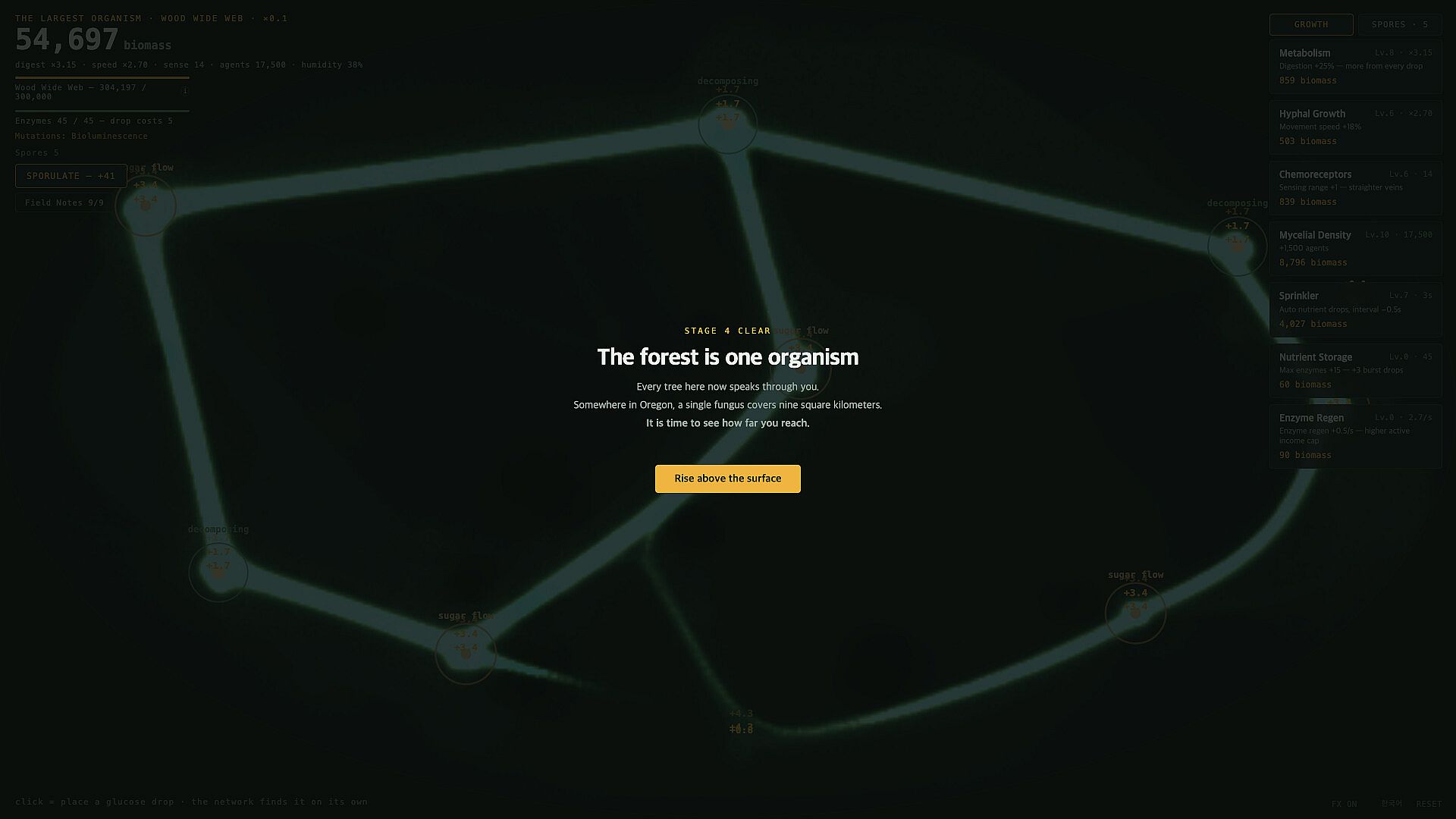
Progression moves through four distinct habitats that shift the scale and challenges. The sequence begins in a laboratory dish viewed at high magnification, then advances to a rotting log, a toxic forest floor, and finally a symbiotic connection with tree roots known as the Wood Wide Web. After these stages the view expands outward to compare the player's colony against the actual record holder. All visuals and audio emerge from live agent calculations and code-based synthesis rather than pre-made assets.
Game Modes
The experience runs as a single continuous campaign that incorporates both active management and passive elements. While away from the game, the colony can colonize carcasses to generate resources that continue accumulating. This idle system operates within a defined playtime of roughly six to ten hours that leads to a clear conclusion rather than endless expansion.
Prestige resets introduce a generational layer. Players select which mutation carries forward into the next attempt, with the choice carrying an explicit cost that influences future runs. The structure encourages experimentation across multiple playthroughs while maintaining a finite overall arc.
Progression and Habitats
Each habitat introduces new environmental pressures that affect how the colony expands and survives. The laboratory dish emphasizes precise early growth under controlled conditions. Later stages add toxicity, competition from other life forms, and opportunities for symbiotic relationships that change resource flows. The final satellite perspective provides a direct size comparison that ties the simulation back to documented real-world biology.
Field notes integrated into the game explain the scientific foundations for these systems. Entries cover topics such as slime mold navigation experiments, fungal responses in contaminated environments, and network behaviors observed in actual mycelial growth. Where the simulation simplifies real processes, the notes identify those adjustments.
Is It Worth Playing?
This simulation suits players who enjoy watching emergent systems develop over time and who appreciate mechanics that reward careful observation rather than rapid reflexes. The combination of active upgrades and honest idle progression creates a loop that feels complete once the ending comparison is reached. Multiple prestige cycles allow further exploration of mutation combinations without requiring hundreds of hours. The focus on verifiable scientific concepts adds depth for those interested in biology, while the compact scope and lack of ongoing live-service elements keep the experience self-contained. Those seeking short-to-medium length single-player simulations with meaningful trade-offs in growth choices will find the systems rewarding.











