


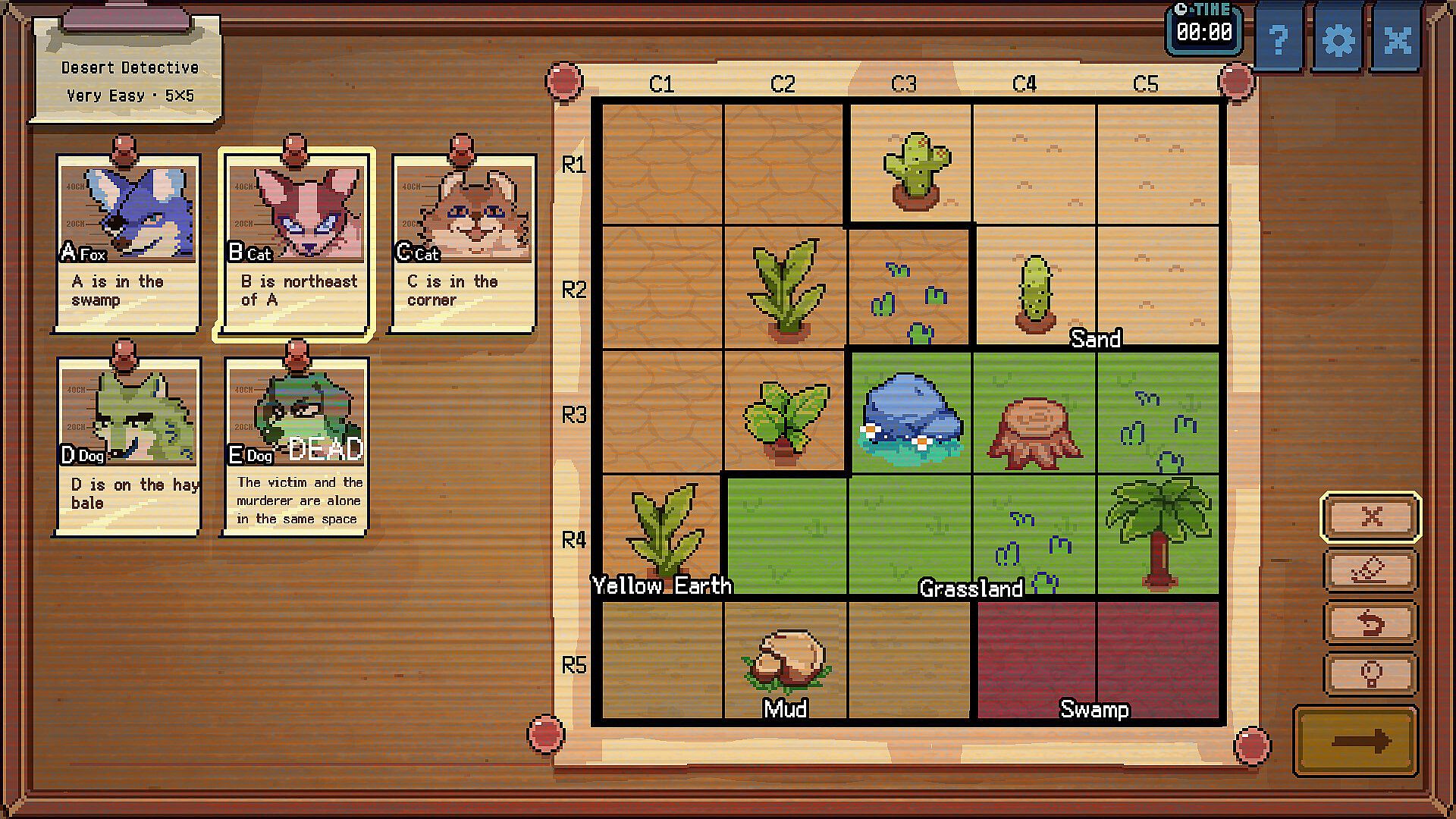
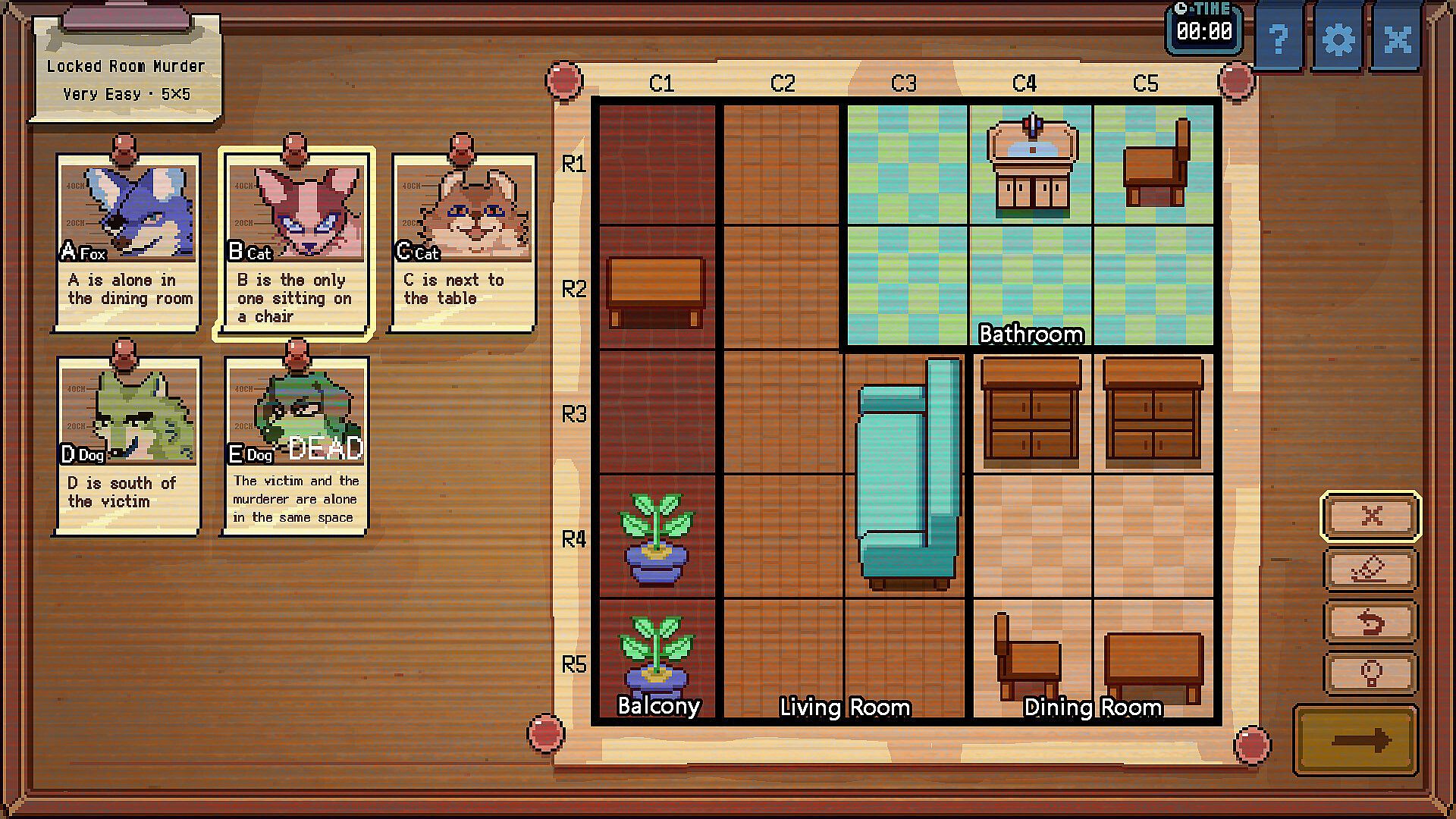
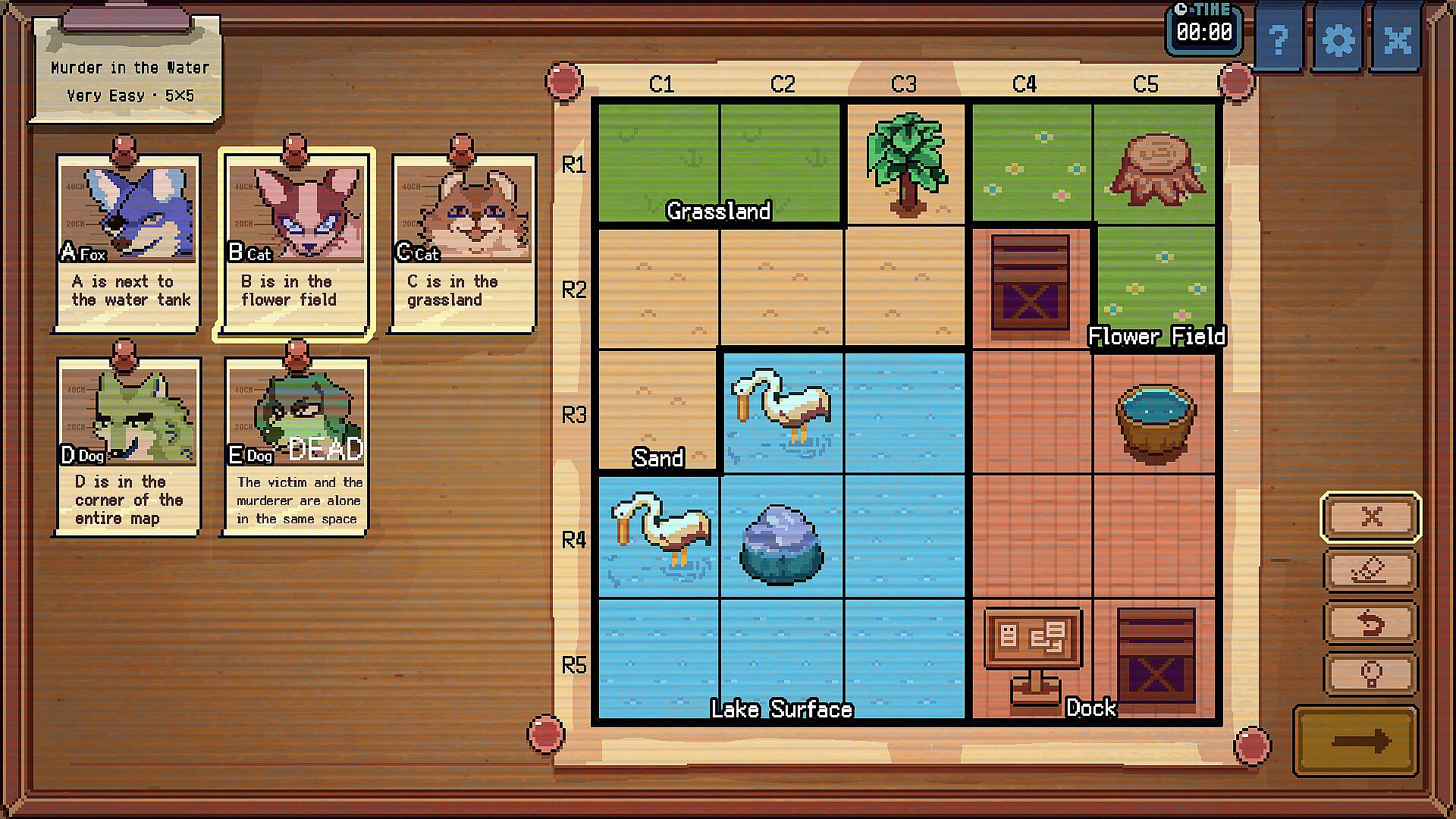
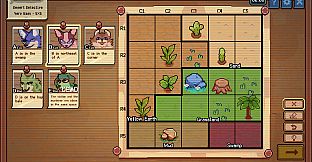
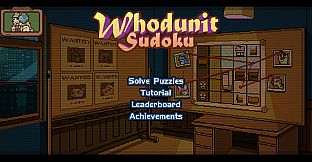
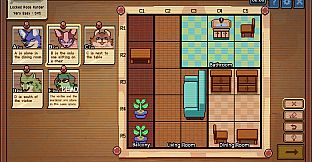
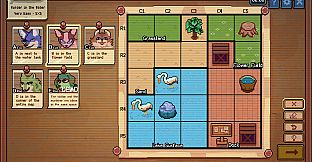
Whodunit Sudoku is a single-player strategy game that merges classic Sudoku placement rules with murder mystery deduction. Set on illustrated crime scene grids, the experience challenges players to arrange suspects while satisfying spatial clues and room boundaries to reveal the killer through pure logic.
Gameplay
The core loop centers on grid-based placement where every suspect occupies a unique position in each row and column. Crime scenes feature distinct rooms defined by walls and doorways, along with furniture and open floor tiles that restrict valid placements to empty spaces only. Written clues provide precise spatial information, covering directions, proximity, relative positions, and boundaries that must all align in the final layout.
Progression builds through careful elimination. Initial placements follow the Sudoku constraint of one suspect per row and column. Clues then narrow options further by describing relationships to the environment or other suspects. The process demands attention to every detail, as a single inconsistency invalidates an entire arrangement. Once the grid fills completely, the killer stands out as the sole suspect sharing a room with the victim.
Each puzzle emphasizes deduction without any element of chance. Players analyze how furniture and walls create isolated areas, ensuring clues about proximity or boundaries fit exactly. The illustrated scenes add visual context that reinforces the logic, turning abstract rules into concrete spatial problems. This structure rewards methodical reasoning and pattern recognition over speed or trial and error.
Game Modes
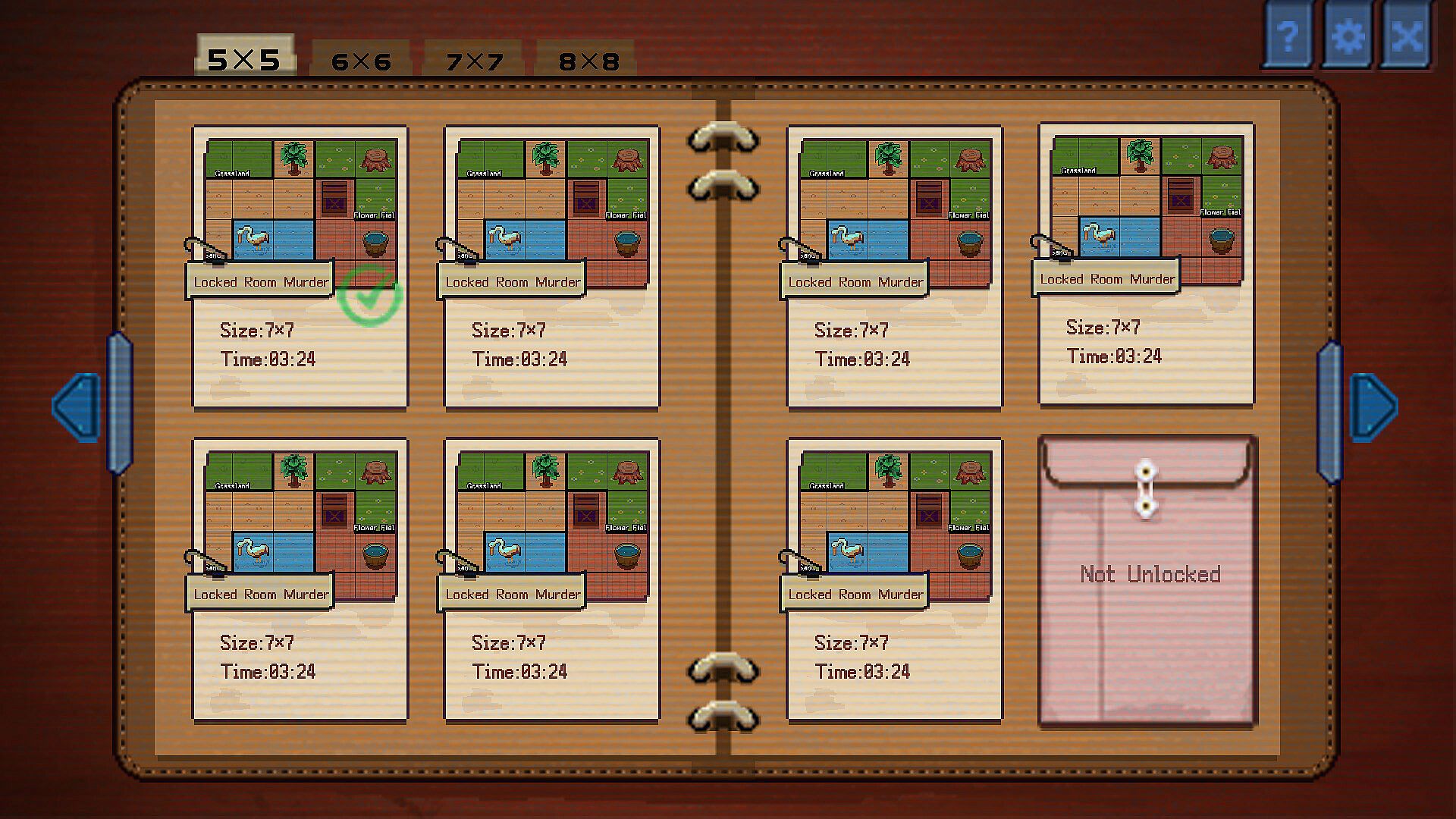
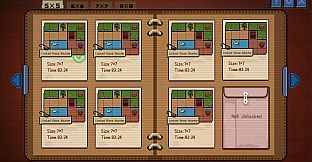
Whodunit Sudoku focuses on individual puzzle cases rather than varied competitive or cooperative formats. Each case presents a self-contained crime scene grid with its own set of suspects, victim, and clues. Players tackle these sequentially or select from available cases, applying the same placement and deduction rules across different layouts and clue combinations.
The single-player format allows uninterrupted focus on logical progression. Cases vary in complexity through grid size, number of rooms, and clue density, encouraging repeated play to refine deduction techniques. No additional modes introduce timers, scoring systems, or external elements beyond the core logic challenge.
Puzzle Design
Design choices prioritize clarity and consistency. Rooms function as logical zones where boundary clues limit suspect movement, while directional and proximity clues create interlocking constraints. Furniture and walls serve as fixed reference points that clues reference directly, turning the environment into an active part of the solving process.
Clue types work together to eliminate possibilities systematically. A directional clue might restrict a suspect to one side of a room, while a boundary clue prevents placement across a wall. Relative position clues link multiple suspects, building chains of deductions that resolve the entire grid. This layered approach ensures solutions emerge only when every clue integrates without contradiction.
Is It Worth Playing?
Whodunit Sudoku suits players who enjoy Sudoku and other logic puzzles that reward careful analysis. The murder mystery framing adds thematic engagement without altering the deduction focus, appealing to those who prefer puzzles that feel like investigations. With no guessing required and an emphasis on strict logical rules, it provides a satisfying experience for dedicated solvers.
As an upcoming title with no user reviews available, its value depends on individual preference for grid-based deduction games. The single-player structure supports extended sessions of focused puzzle solving, and the verified mechanics deliver consistent challenge through spatial and relational clues. Those drawn to pure logic without additional layers will find the core loop engaging once the game releases.