




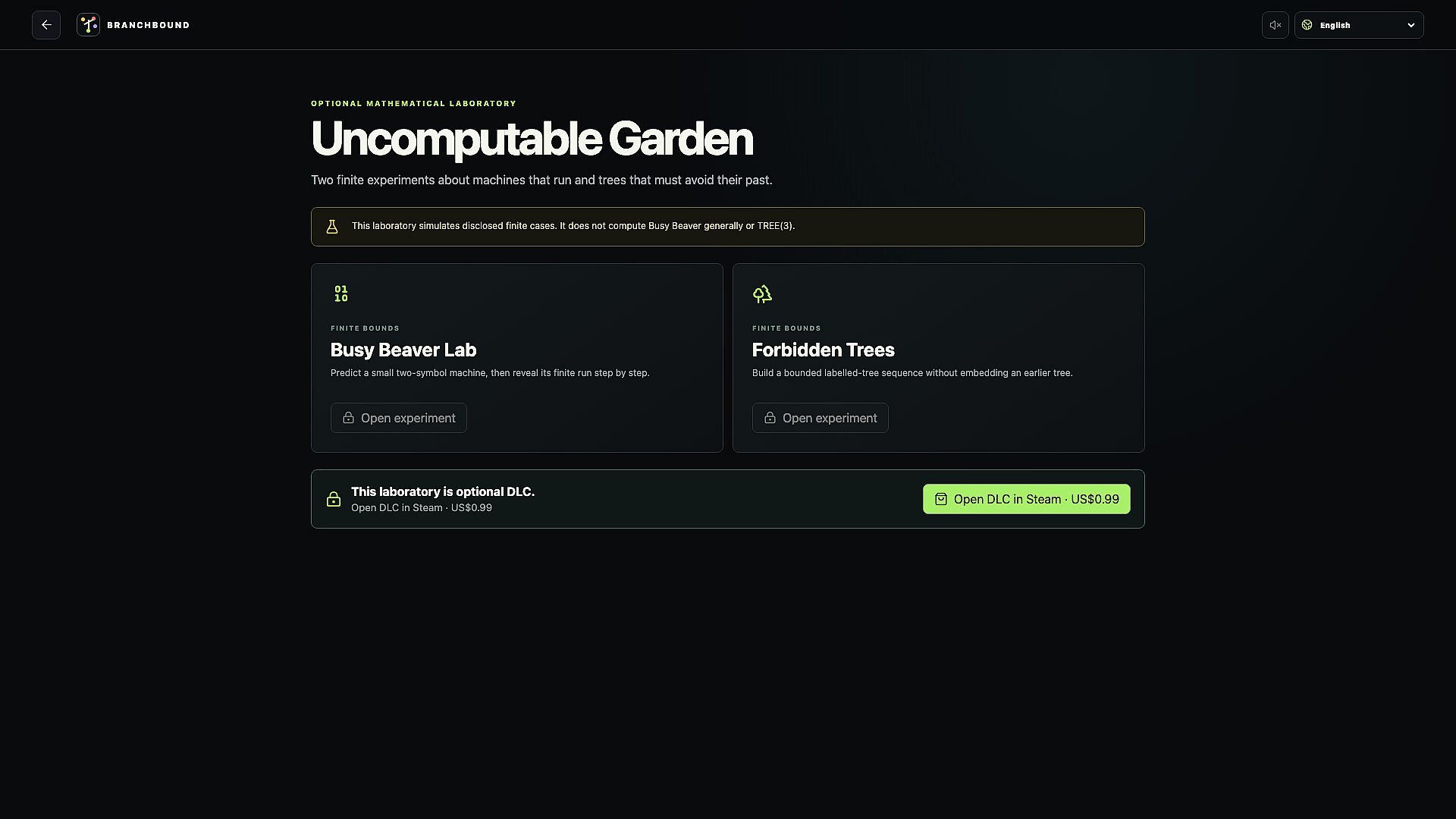
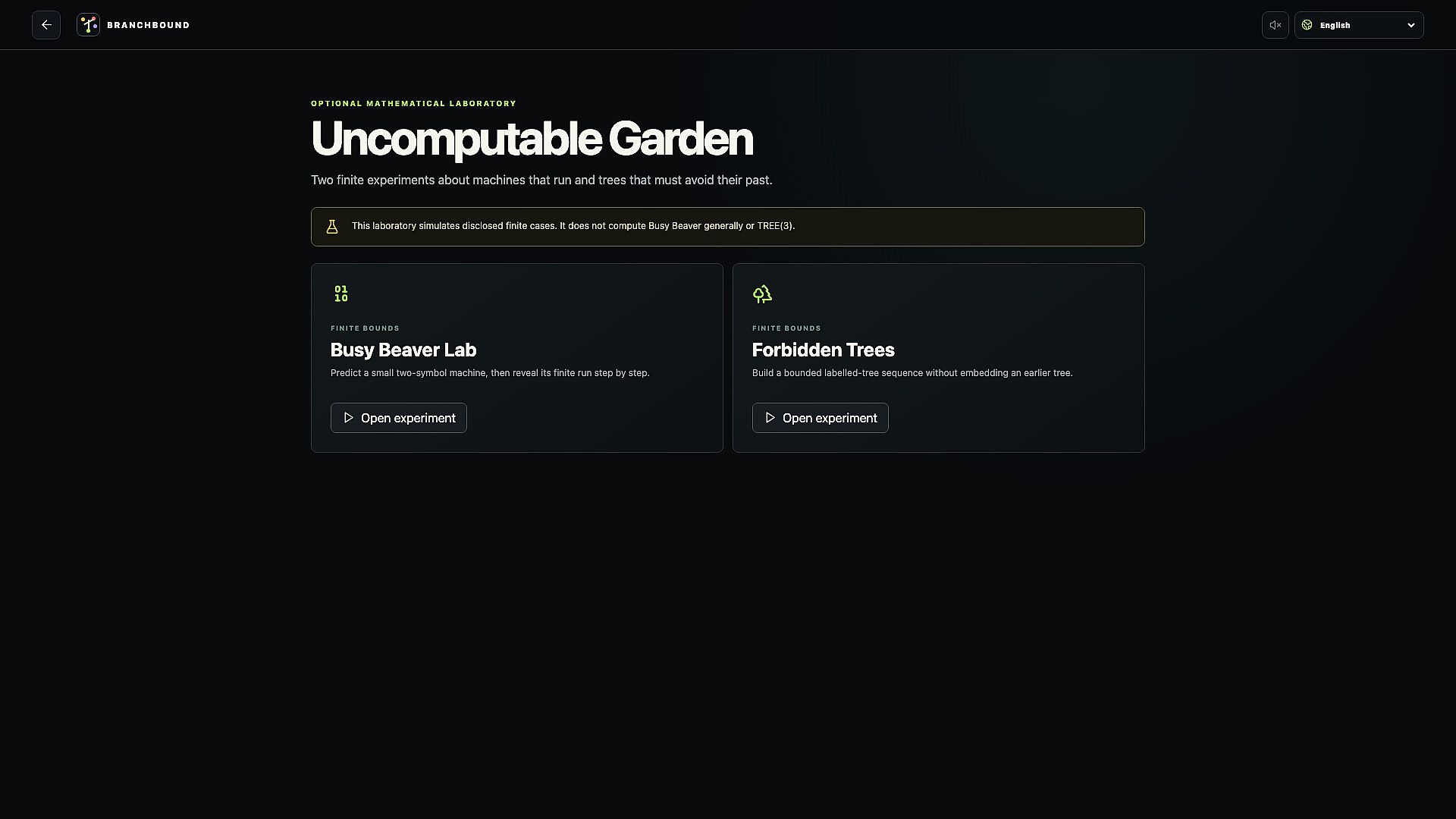
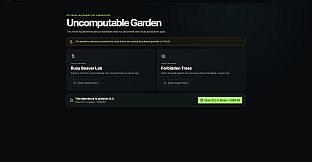
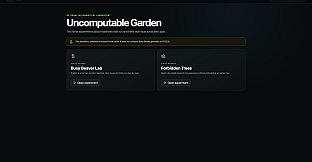


Branchbound: Uncomputable Garden is a strategy indie title for PC that adds two focused mathematical experiments to the core tree-growth mechanics of its base game. Players enter a compact laboratory setting to test bounded sequences and machine behaviors under strict limits, all presented through deterministic rules that emphasize prediction and comparison rather than open-ended simulation.
Gameplay
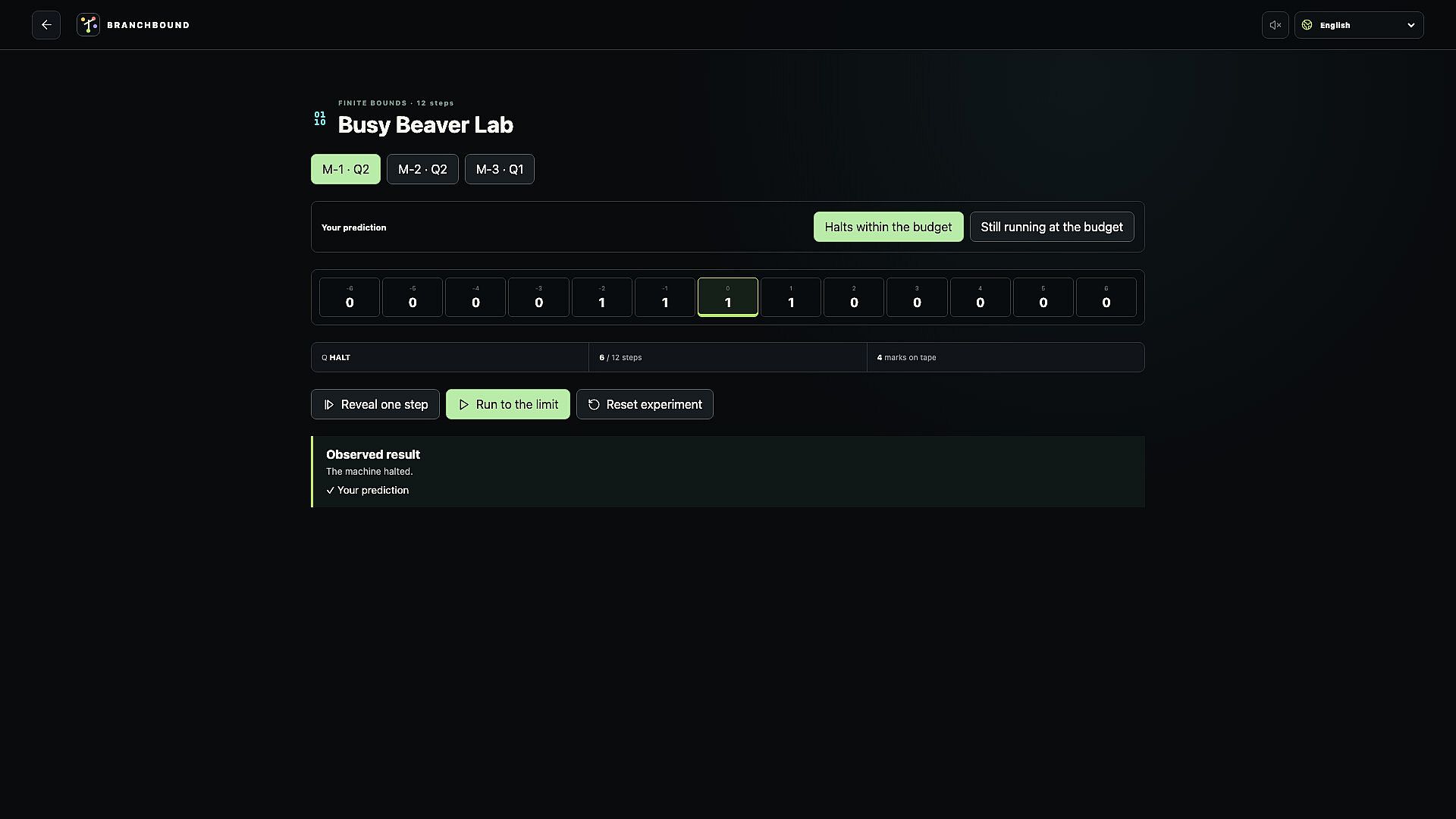
The experience centers on two self-contained experiments that run entirely offline. In the first, participants predict the behavior of a curated two-symbol Turing machine by stepping through its finite execution one move at a time. Observed runtime and tape marks are then matched against a disclosed upper bound shown on screen at the start. Every step remains visible and verifiable, so the process stays transparent from beginning to end.
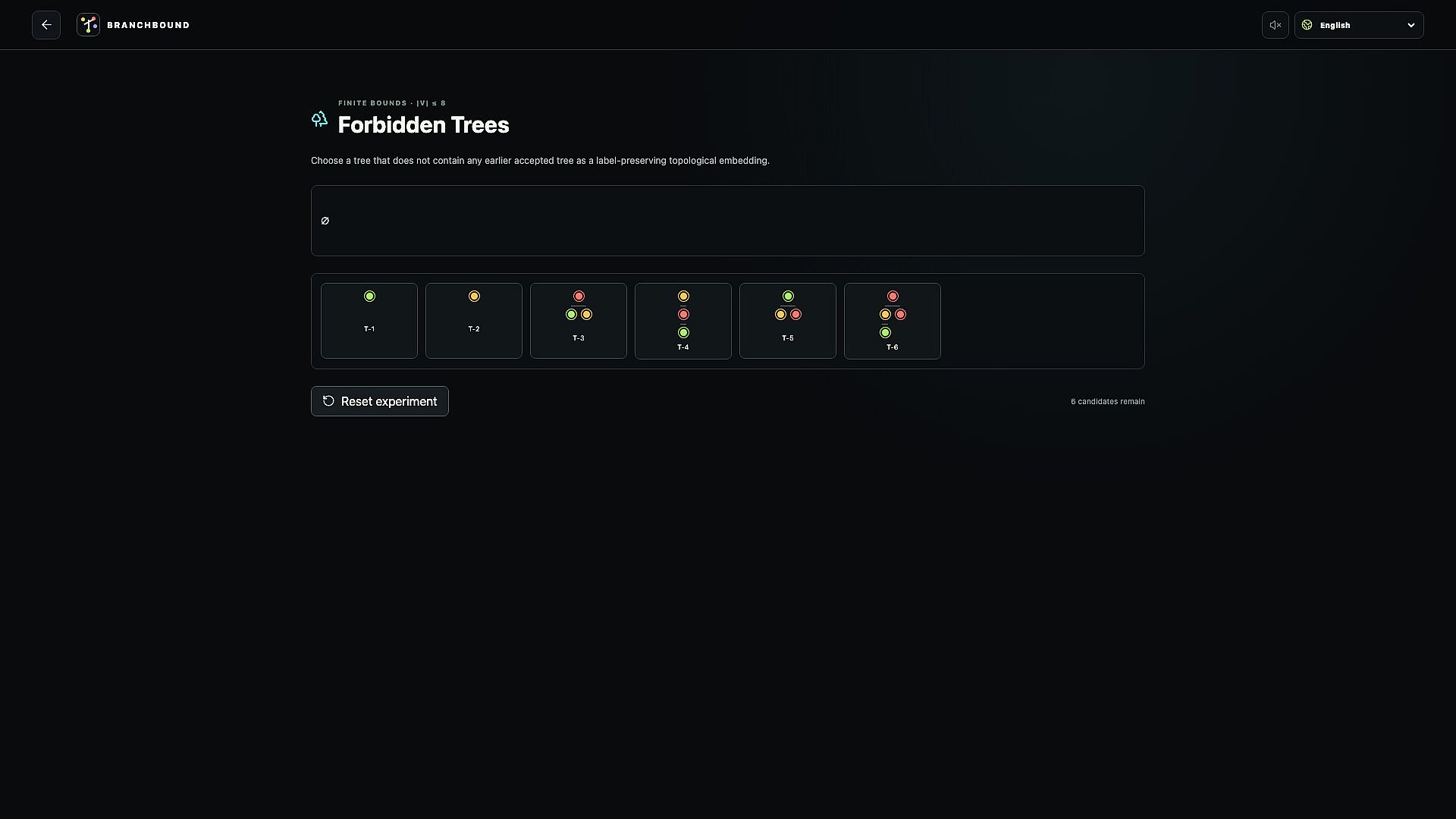
The second experiment requires building a bounded sequence of finite labelled rooted trees. Each new tree must respect a clear embedding rule: a choice becomes forbidden if any earlier accepted tree can embed into it while keeping labels and branch structure intact. Bounds appear explicitly before play begins, and the system never implies an infinite or uncomputable continuation.
Both experiments support repeated runs with identical starting conditions, allowing direct comparison of different prediction strategies or construction orders. Controls remain simple and local, with no external accounts, servers, or background processes required.
Game Modes
Busy Beaver Lab forms one complete mode. It presents a single curated Turing machine per session and guides the player through step-by-step revelation of its execution. The mode ends once the disclosed limit is reached or the machine halts within bounds, after which runtime and tape statistics are displayed for review.
Forbidden Trees serves as the second mode. Players construct successive labelled rooted trees inside a fixed size envelope. At each step the interface flags any move that would allow an earlier tree to embed into the new one, preserving the exact label and branch relations. The sequence stops when the bound is met, and the full history remains available for replay or analysis.
Both modes operate independently yet share the same offline, deterministic framework. No additional modes, factions, or variable difficulty layers appear beyond these two experiments.
Core Mechanics and Design
Every limit is declared upfront, so the phrase "still running at the limit" always refers to a concrete, visible boundary rather than an open question. The design avoids any claim of general computation for Busy Beaver problems or approximation of larger uncomputable functions such as TREE(3). Instead, the focus stays on small, fully disclosed instances that reward careful observation and pattern recognition within strict constraints.
Progress saves locally on the device, and each experiment can be restarted from the same initial state for side-by-side comparison of different approaches. The presentation remains minimal, directing attention to the mathematical rules and their immediate consequences.
Is It Worth Playing?
Branchbound: Uncomputable Garden suits players who enjoy precise, rule-driven strategy puzzles and short, repeatable sessions. Its two experiments deliver clear, bounded challenges that emphasize prediction and verification over long campaigns or competitive ladders. Because the content requires the base game Branchbound and runs completely offline with no ongoing updates or additional purchases needed, it appeals most to those already familiar with the core tree-growth rules and seeking a deeper mathematical layer. With no user reviews available shortly after release, prospective players should evaluate the experiments through the provided descriptions and any available trial access before committing. The package offers a focused, self-contained addition for anyone interested in abstract strategy grounded in finite mathematical structures.